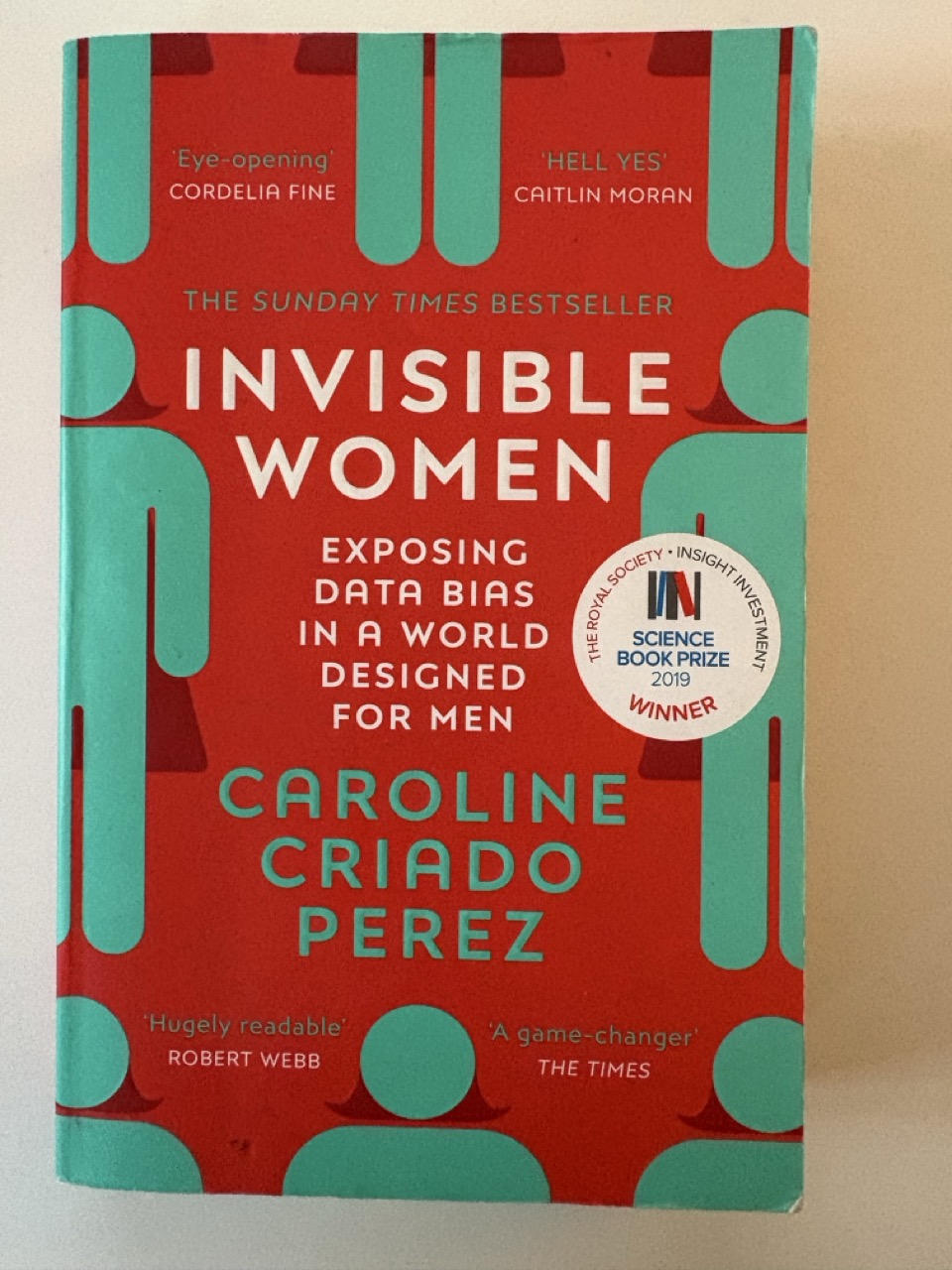
Besides reading novels or fiction, I like to read books that are very information dense. Invisible woman is a perfect example of how you can put a lot of research and proof together to still be able to read it as one coherent piece.
Albeit a frustrating read at points, this is certainly a book that I would recommend to everyone, especially men, and especially those that work within research or with data. This book clearly shows that, while there have been major societal improvements for woman, the existence of clear data gap between sexes is still very real.
Criado Perez points at the data bias and data gaps in various layers of our society, to get a sense of the scale and depth of these issues I will share some in this article, but I highly encourage you to read the book for yourself.
Let’s start with a familiar one, if you have ever been to a large event, busy bar or club, you have probably noticed the long queues at woman’s bathrooms and none at the mens. This is a result of plumbing design decisions that state 50/50 floor space division of toilets, without taking into account that, through the availability of urinals, there are often more toilets for men than women. Even when evenly divided, woman take on average up to 2.3 times longer to use the bathroom. Issues around sanitation are not only present at event venues, but also in the public space. According to the UN, one in three woman lack access to safe toilets. This is not just a problem in poor countries, a trend has been revealed in public-toilet closure in both the US and UK, with the latter closing 50% of public toilets between 1995 and 2013.
On of the bigger topics that Criado Perez discusses is unpaid work, of which 75% is done by woman. While improvement can perhaps be seen on local or individual level, on a global level this seems to remain the same. Under unpaid work we should not only think about household work, but also childcare and caring for sick relatives or elders with dementia. To understand the importance of this unpaid work, I recommend also watching “A Day Iceland Stood Still” which is about protest of Icelandic woman in 1975 where on 24th of October, not one woman did a single lick of work 1. This paved the way for the passage of a guaranteed equal rights law and the first elected female president in 1980.
Evidently, the failure of measuring unpaid household services creates perhaps even the biggest gender data gap of all. With enormous underestimated economic value going up to 50% of GDP in high-income countries and as much of 80% in low-income countries. When countries are cutting public services, woman are often the one who end up paying the price, since the work still needs to be done. This is what happens when unpaid household and carer work by woman is seen as a costless resource to exploit.
After diving into countless studies, Criado Perez found that a lot of studies do not even have sex desegregated data, leaving valuable information on the table. A common issue here is that in most cases, products are only designed around a standard human, which mostly translates to a man, going from size of keyboards and phones to voice-recognition software in cars that only respond to a man’s voice. This is also enforced since a lot of tech companies are actually founded by men and backed by VC (Venture Capitalists), also 94% male.
Even for crash tests with cars, the dummies that are used are based on a man’s body. Only since 2015 EuroNCAP has started to use both male and female dummies, where in some case the female dummy, is just a scaled down male dummy. Which is, when looking at lower bone density and muscle-mass distribution, not the same as a female body.
Perhaps even more shocking this also happens in the medical world, where you would expect it to be clear that sex differences exist, this is still to often not taken into account, leaving a data gap and a lot of room for improvement. Research from 2014 showed that even for studies that focused on female-prevalent diseases that specified sex (44%), only 12% studied female animals. Arguments for this inadequate representation start from a historical problem of seeing the male body as a default body to arguments stating that the woman’s body is too complex, too variable and therefore to costly to be tested on. Which I think is exactly the same argument that can be used to stress that woman should be included in medical studies.
This article only shows a glimpse of the data bias issues that Criado Perez exposes in her book. Let this be a motivation for each to learn more how gender plays a role in our society and how we can adequately address this from here on.